Island Updates

Living on the Edge Jr 2015

Post by Olivia and Jacque, Program Leads

Learning about bees with Sam, click to see the full photo gallery from the program.

Learning about bees with Sam, click to see the full photo gallery from the program.

Last Monday, our final program of the summer began. Eight middle school students stepped off the boat beaming with excitement to spend a week on Hurricane Island. The first day was spent exploring the island on a history hike and sustainable systems tour, while eating plenty of raspberries along the way. The students even practiced using a model derrick, a human-powered crane used to move blocks of granite during the quarry era. The rest of the day was spent learning about what it means to be a naturalist and learning how to use tools such as the microscope, hand lens, and binoculars.

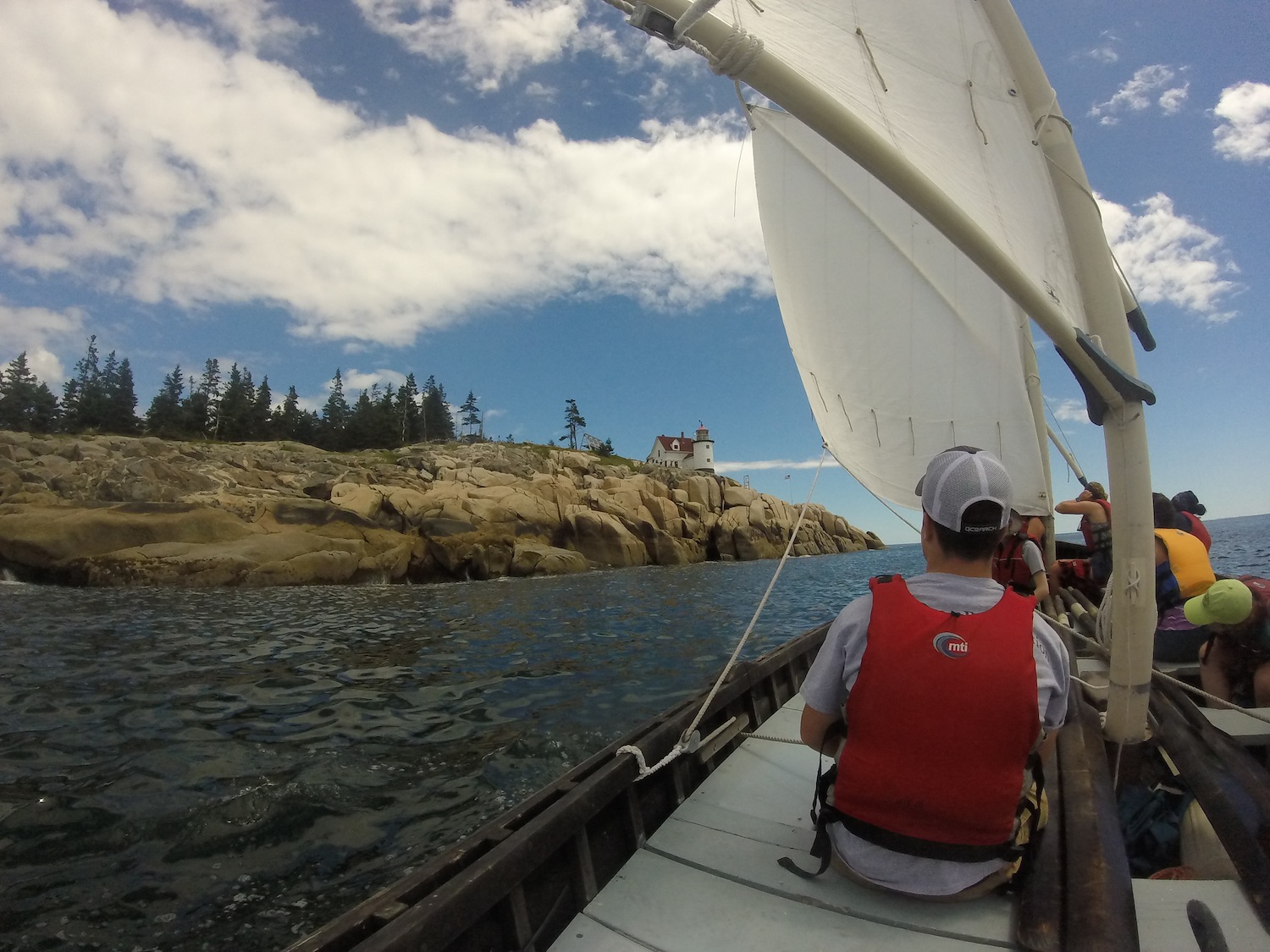
Tuesday started off in the lab, where we discussed the basic anatomy of insects and which kinds of insects are pollinators. This led into the next portion of the morning: a field trip to the South End to see Sam’s honey bees! Sam explained to us the three types of honeybees, how the hive is built, and the steps worker bees take to produce honey. We even tried some fresh honey straight from one of the combs! After seeing the bees up close, we raced back to the lab to grab nets and jars to collect our own bugs. The students headed up to the church and shower house, where they found butterflies and a few large spiders as well as plenty of grasshoppers to chase.  Students then drew insects from our own bug collection, and used watercolor to bring the illustrations to life.  After a morning on land, we loaded up on the sailboat in the afternoon and hit the water.  While there wasn’t too much wind, there was plenty of sunshine and laughter aboard the boat. While sailing, we practiced our knots and caught a glimpse of the seals using our binoculars. The group sailed over to neighboring Greens Island to explore turtle rock and some of the beaches. After dinner that night, we took off for Gibbon’s Point to have our evening meeting while the sun set in the distance.

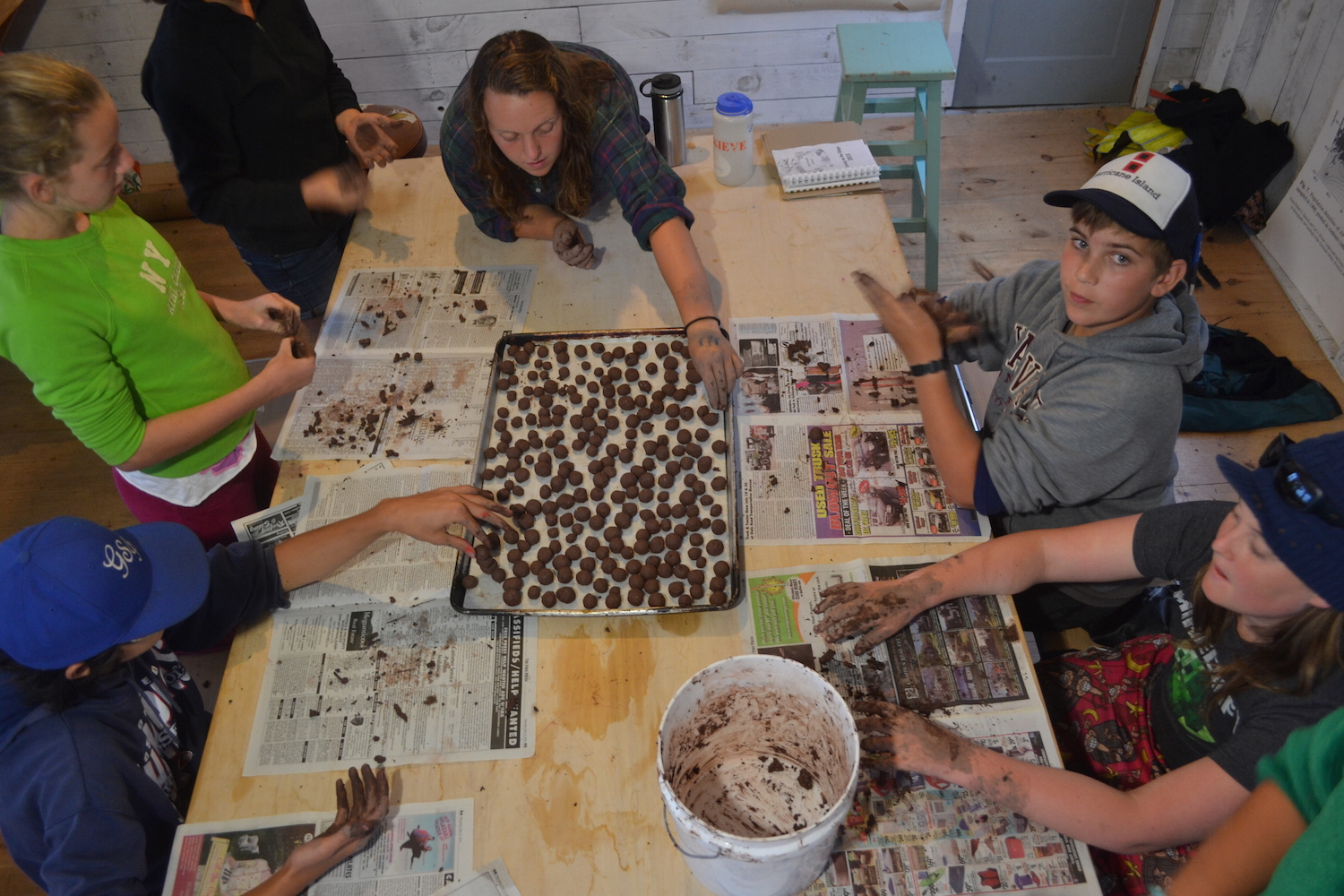
Wednesday morning was devoted to botany and searching the island for edible plants. Before we set out to hike the perimeter, we went over basic plant parts and ways to group plants to make them easier to identify. This prepped us to look for all the plants we could nibble on as we walked. The students learned to identify many types of trees, shrubs, flowers and ferns, and were brave enough to try any and all of the edibles that were presented to them.  Afterwards, we foraged for beach rose, red clover, and raspberries around the island. We then headed to the kitchen, where we whipped up a simple syrup and a raspberry chocolate crumble bars for a lunch time dessert. During free time, we all jumped off the pier and then went fishing off the pier. The afternoon was spent rock climbing in the quarry. Students had a blast challenging themselves to climb different routes on the main face. That night, we fished for squid off the dock (perhaps a Hurricane first!). Although we were not successful catching squid, we played with the bioluminescent plankton in the water. Certain types of plankton utilize chemicals to produce light as a defense mechanism at night. Some plankton even squirt globs of bioluminescent goo to confuse their predators. By moving the water around, you get front row seats to a magical display of lights!

Thursday began with an intertidal exploration at Two Bush Island. Back at the lab, we took a closer look at our intertidal finds, which included a tiny lobster and a very cute lumpfish. We also used delicate species of algae to make colorful seaweed art that students took home with them. Chloe joined us in the afternoon to teach us all about bird adaptations and the kinds of birds we have here on the island. The students learned how different shape and size adaptations make some birds great at swimming while others eat insects on trees! We quietly walked along the shoreline to spot a few sea birds, while also practicing our bird calls. Chloe then challenged us to build a nest that could withstand wind, water and hurricane conditions. Our last night was spent around a warm campfire, where we enjoyed s’mores and sang campfire songs.

The morning of our final day was spent painting birdhouses that were built by previous HICSL students. The students worked in teams to decorate each birdhouse, which will soon be installed around the island. Following our art activity in the morning, the students took off with Olivia and Jacque to tackle a scavenger hunt. We raced around the island in search of hidden clues that brought us to our final riddle: Boomer, our island dog! Saying goodbye to this group was tough, as their enthusiasm for exploring and love for learning was contagious. This group had us laughing, dancing, and singing all week. We hope everyone has a wonderful final stretch of summer and start to the school year!

Subscribe in a reader

Wilderness Advanced Life Support

This is the second year we have hosted a Wilderness Advanced Life Support (WALS) certification course on Hurricane. We were joined by a talented group of participants with backgrounds ranging from emergency nurses to an anesthesiologist. One of the most challenging aspects of this course for participants is that they are no longer in a familiar resource-and-expertise-rich hospital environment, and have to improvise with the medical bag they brought to the scene, trying to stabilize a situation without much outside support and working with a real time delay until they can evacuate their patient to definitive medical care. 

Olivia, Alice and Chloe get into character before the final evening scenario

One of my favorite parts of this course is that Hurricane staff get to help out and act as patients during full-group scenarios. During the final evening scenario we got moulage to simulate our bruising and open wounds, and we were also given a laundry list of symptoms and afflictions ranging from a dislocated patella to a traumatic brain injury (TBI) to an amputated hand. Covered in fake blood and strewn across the field, we waited to be approached by the response team. You can learn a lot about emergency situations by participating in a scenario-- it was incredible to hear how the team communicated information about their patients, worked out an evacuation plan, and triaged the situation. They worked calmly and efficiently, and recognized each others expertise in certain areas, passing stabilized patients off to one another in order to fully attend to the more extreme injuries. 

Everyone on the course was up to the challenge and got out of their comfort zone to learn a new set of skills and apply their medical knowledge to dealing with emergencies in a wilderness setting. We are looking forward to more WALs programs, and hope to see everyone who participated back out on Hurricane Island in the future!

Subscribe in a reader

Living on the Edge 2015

Post by Olivia Lukacic and Chloe Tremper, Program Leads

We were living on the edge this week - exploring all that Hurricane Island has to offer with five awesome middle school students! For the week of August 9-15, we honed our naturalist skills and furthered our understanding of marine and terrestrial ecosystems through lots of art and exploration. The students arrived on a beautiful, sunny Hurricane day and were only on island for an hour or so before our first brave pier jumper took the plunge into the icy Atlantic! The rest of the day was filled with the always fun history hike with a sustainability twist as well as team building games.

Our first full day as a group started off with a bang! Chloe started the day off teaching about bird adaptations and introducing some of Hurricane’s most common bird species. We looked at what types of wings, beaks, and feet shapes would be best suitable for a variety of conditions, challenged each other to a nest building challenge to see whose nest could withstand the most weight, and played a hilarious game of "here I am, where are you." This game is all about trying to find your partner with a pre-determined call while you are both blindfolded and music is blasting all around. We realized how hard it could be for birds to communicate in their environment and how their songs may be adapted to their environment, while also entertaining some of the HIF staff and visitors. In the afternoon, we went with Jacque into the intertidal to learn about how animals and plants adapt in a constantly changing marine environment. We found amazing things at Two Bush Island including brittle stars, sea stars, hermit crabs, three varieties of other crabs, sea urchins, seas sponge, tunicates, and four lumpfish! We brought our species back to the lab to use our observation skills to draw the creatures and look at them under the microscope.

Tuesday was a botany bonanza! We started off with an island perimeter hike to learn how to identify plants in the field and we also collected plants that caught our eye. Back in the lab, we learned how to use field guides - this involved racing to identify plants using the dichotomous key in Newcomb's Wildflower Guide and a tree-detective game that challenged students to describe plants with proper botany vocabulary and match up mystery species to tress listed in The Forest Trees of Maine. The afternoon was our first day of rock climbing! The students learned how to belay and get used to climbing before moving to the big wall. Once at the big wall, the students were climbing machines – completing some of the most challenging climbs with ease!  After climbing, we stayed at the rock face for a little bit and collected lichens and mosses to take back to the lab and learn about.

Students build birdhouses. Click through for more photos from the program.

Students build birdhouses. Click through for more photos from the program.

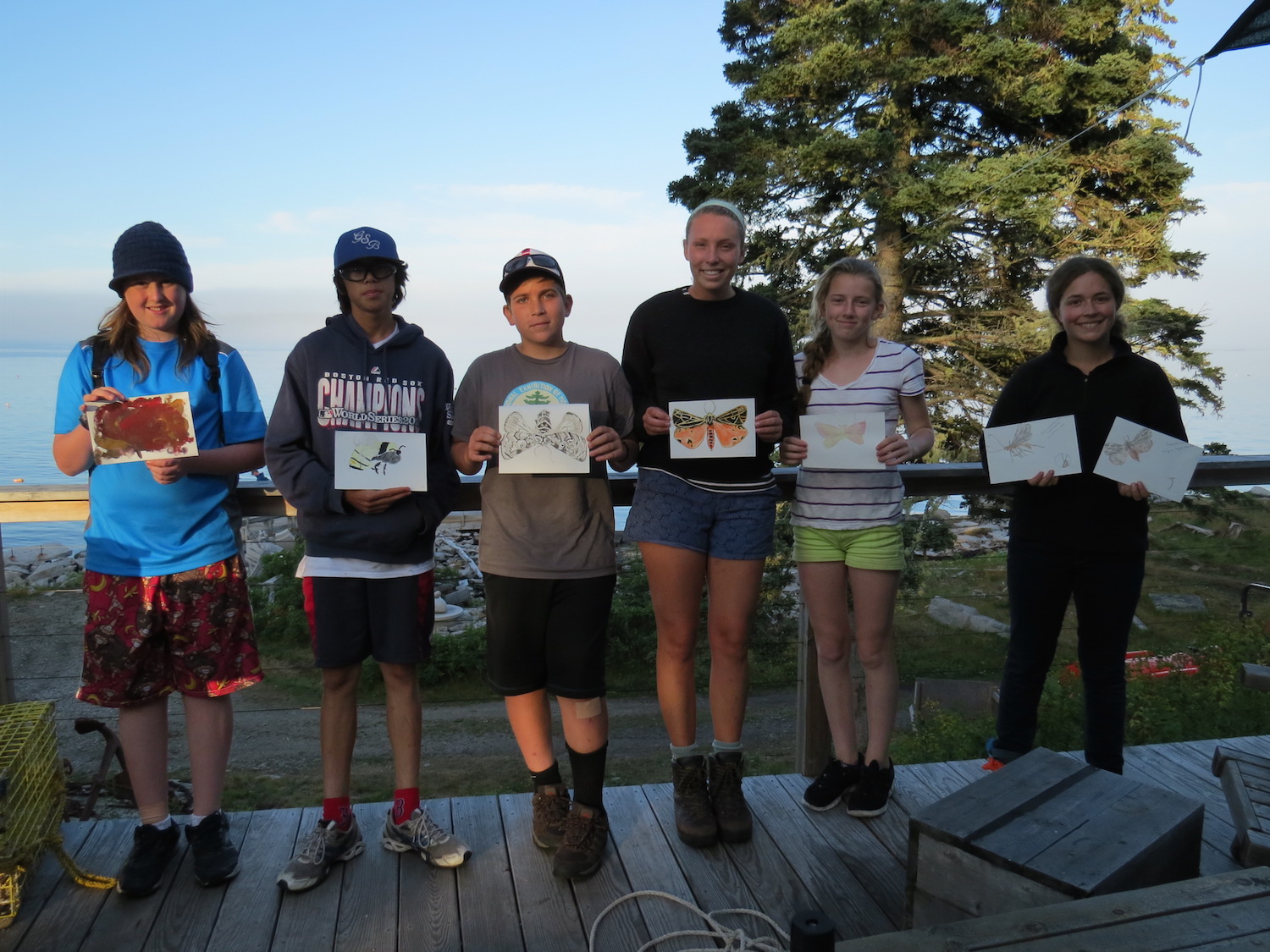
Due to some foggy, wet, and windless weather our planned sailing day on Wednesday turned into an awesome art and building day! The students started off the day building and painting their own bird boxes. These weren’t your run of the mill bird boxes, however - these have a plexiglass back that allow the students to observe the nest building process. Each student constructed, painted, and took home their bird box.  Most of the plexiglass was painted over to give the birds’ privacy with viewing holes left unpainted.  The rest of the day was spent exploring the world of bugs and learning about the importance of pollinators.  We played a super fun pollinator game developed by Olivia and used watercolors to make observational drawings Hurricane’s bug collection.

The next day, after another morning of climbing, the students spend the afternoon with Josie Iselin.  Josie is the photographer, author, and designer of seven books all of which focus on the forms in nature we find at hand, especially those found at the beach. Some of her books include An Ocean Garden, Seashells, Heartstones, and Beach: A Book Of Treasure.  Upon her arrival, Josie gave a brief presentation to the students and our staff about herself and her work and then we headed into the intertidal with her to explore all of the different types of seaweed Hurricane’s coast has to offer.  We had a ton of fun holding different seaweeds up to the sun to admire their colorations and aging knotted rack by its bubbles!

The last full day of Living on the Edge consisted of a morning sail over to Crane Island where we picnicked and explored followed by an afternoon of individual project time! The students were given creative freedom to create a piece of art, or multiple pieces, that related to what they did and learned on Hurricane over the past week.  All the projects were AMAZING and very different from one another. Some students worked with washed up buoys from our buoy pile creating sculptures, painting them, and even decorating them with pressed flowers.  One student used leaf prints to create a backdrop for the Hurricane flag and another made a three-dimensional topographic map of Hurricane out of cardboard. 

Students finished up their projects on the final morning and then completed an island-wide scavenger hunt!  The scavenger hunt had the students running all over the island starting off near the galley, heading towards Gibbon’s Point on the north end, then back across the island to points like“the crack,” high cliffs, and the main quarry face.  The scavenger hunt ended with some HIF bumper stickers as the prize and a fun cook-out on the south end.  It was a great way to end a super fun week.  As always we hope the kids had just as much fun as we did and that we see them out on the island next year!

Subscribe in a reader

Summer Flies

Post by Oakely Jackson, Program Instructor

We have been wrapped up in the bustle of summer for several months now. The peak of the season has been marked by a full harbor, a dock jam-packed with tenders and pleasure cruisers and the island alive with plants and programs.  As the so called “Mayor of Hurricane” (I am honored Bob) I have been keeping track of the comings and goings of the island and playing host to the masses, which have been as many as fifty people at times.  That many individuals can sure go through a lot of TP, water and Goldfish. We are kept busy raking the composting toilets flat, filling our beloved blue water jugs on Vinalhaven, and keeping enough vittles on the table.

Our dishes have been supplemented with greens and veggies from our gardens.  The straw bale garden is over-flowing with squash, cucumbers, broccoli and green tomatoes.  The berries are also in season and most guests leave the island with raspberry stained fingers.  We now have a hive of honey bees on the island and the multitude of wildflowers are constantly being plundered of their pollen. In order to provide the bees with a greater variety of options we put in a new flower garden between the flywheel and Sam’s cabin.  Although we have out-witted the deer (I have seen several does and a buck this summer) with our new and improved fencing, we opted to not fence the flowers and there has been a lot of nibbling going on… R.I.P. sunflowers.

Even with plenty of summer left, I am getting the sense that things are starting to wind down. With only a few summer programs to go and the interns leaving soon it is sad to admit that another season is coming to a close.  In the three years I have been on Hurricane, for the first time this summer it has felt like we truly have a functioning community with enough people to run the island and the type of team cohesion that gets you excited to go to morning meeting. A major role in any community is the cook, and Micah brought us all together in the galley, both with the production of food and the sharing of meals. Micah is a techno-crazed magician who can produce the most scrumptious food while never missing a beat. Micah is now off to another island, this time in the Bahamas, and we are left to wonder when the next time we will eat beans out of a pressure cooker will be. You will be missed dearly Bean King, go forth and prosper!

Subscribe in a reader

Marine Biology 2015

Post by Alice and Jacque, program leads

We enjoyed a fun, jam-packed week with a great group of students exploring the marine environment in Hurricane Sound and beyond August 2-8, 2015. On their arrival day, students got oriented to the island by leaning about Hurricane’s quarry history and our current sustainable systems including our solar power array, our constructed wetland for filtering grey water, and our composting toilets. After dinner, we enjoyed a short hike to Gibbons Point to the see the sunset and enjoy each others company.

The Craftier Rafters before deploying their raft in the Ice Pond. Click through for more photos from the program

The Craftier Rafters before deploying their raft in the Ice Pond. Click through for more photos from the program

Our first full day started with a focus on lobster and scallops, two of Maine’s most important fisheries. Bailey, our scallop research intern, showed students how to collect data underwater and explained her current research processing spat (larval scallops) bags. Jacque and Jenn challenged students to use the concepts of density, water displacement and surface area when designing a series of submarines and boats. Everyone had a chance to look at lobsters up close, and learn more about the lobster fishery and about lobster biology. That afternoon, students prepared for the raft challenge by first learning useful knots with Silas and Oakley. Using just bamboo, plastic barrels, different lengths of rope, and their new knowledge of density and knot tying, students were challenged to design a raft in two hours that could successfully float them across the Ice Pond. In the end, team “Craftier Rafters” prevailed with a triangular shaped raft that students rode victoriously across the Ice Pond. The other team,  the “OG Crafty Rafters” faced some challenges with their raft, but as enjoyed working as a team shared lots of laughs and teamwork.

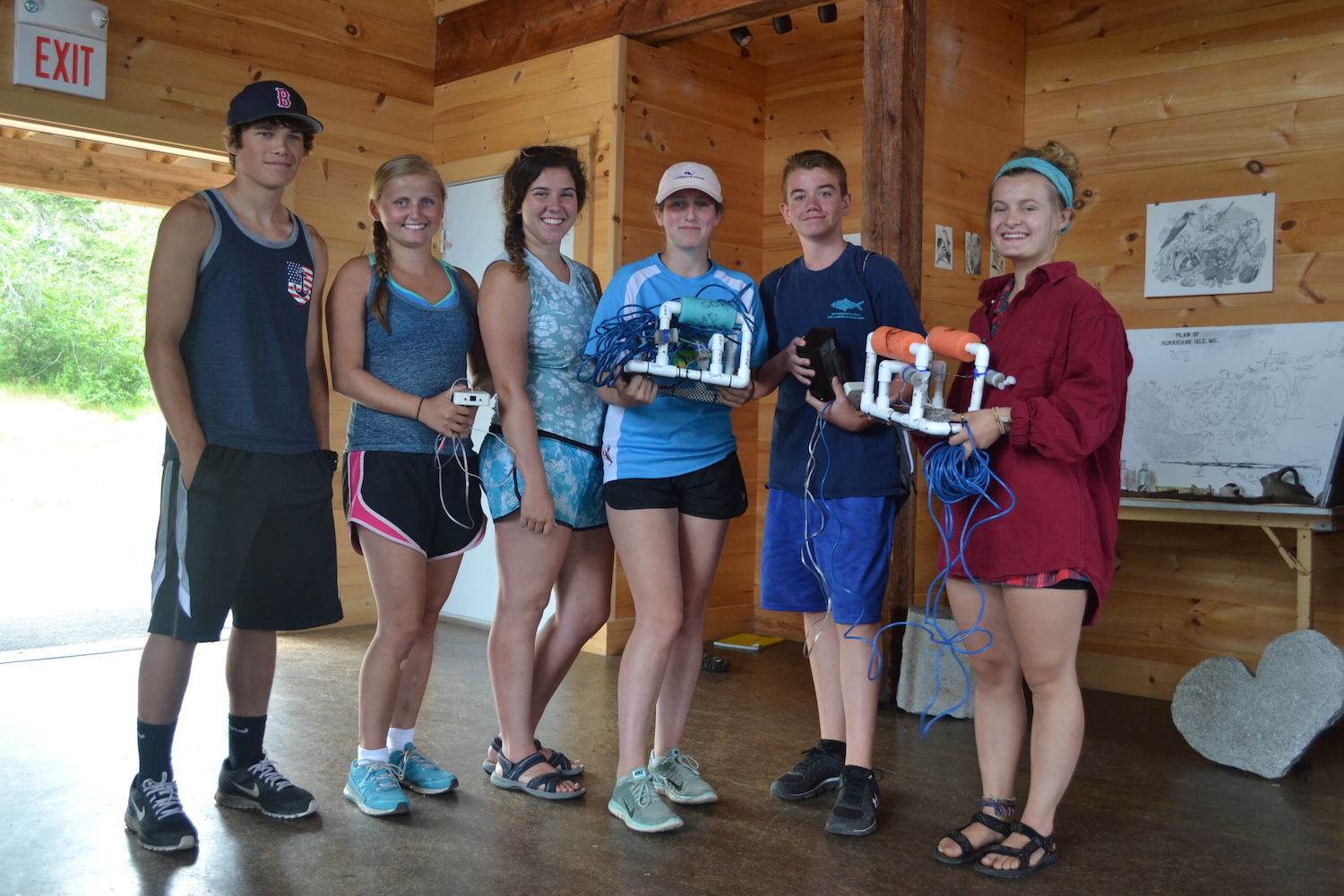
The morning of our second day was spent exploring the rocky intertidal near Two Bush Island and collecting critters to examine back in the lab. Despite a rainy morning, students had a blast working as a team to collect and identify the organisms they found. Using field guides, microscopes, and hand lenses, they identified a total of 27 different species including nudibranchs and waved whelks. Based on their observations of organisms and patterns in the intertidal zone, students split into three groups to formulate different questions to drive their group research projects they would conduct the next day. After lunch, students explored the challenges of underwater engineering as they constructed two Sea Perch, remotely operated vehicles (ROVs) which can move around underwater connected to a tether. Our hardworking students built all the components, including soldering together an electrical control box, making the motors for the propellers water tight, and designing a PVC frame. While two teams tackled the Sea Perch, the other group of students took Hurricane Sound by sail. While sailing, they observed sea birds and utilized map reading to navigate around our rocky coastline.

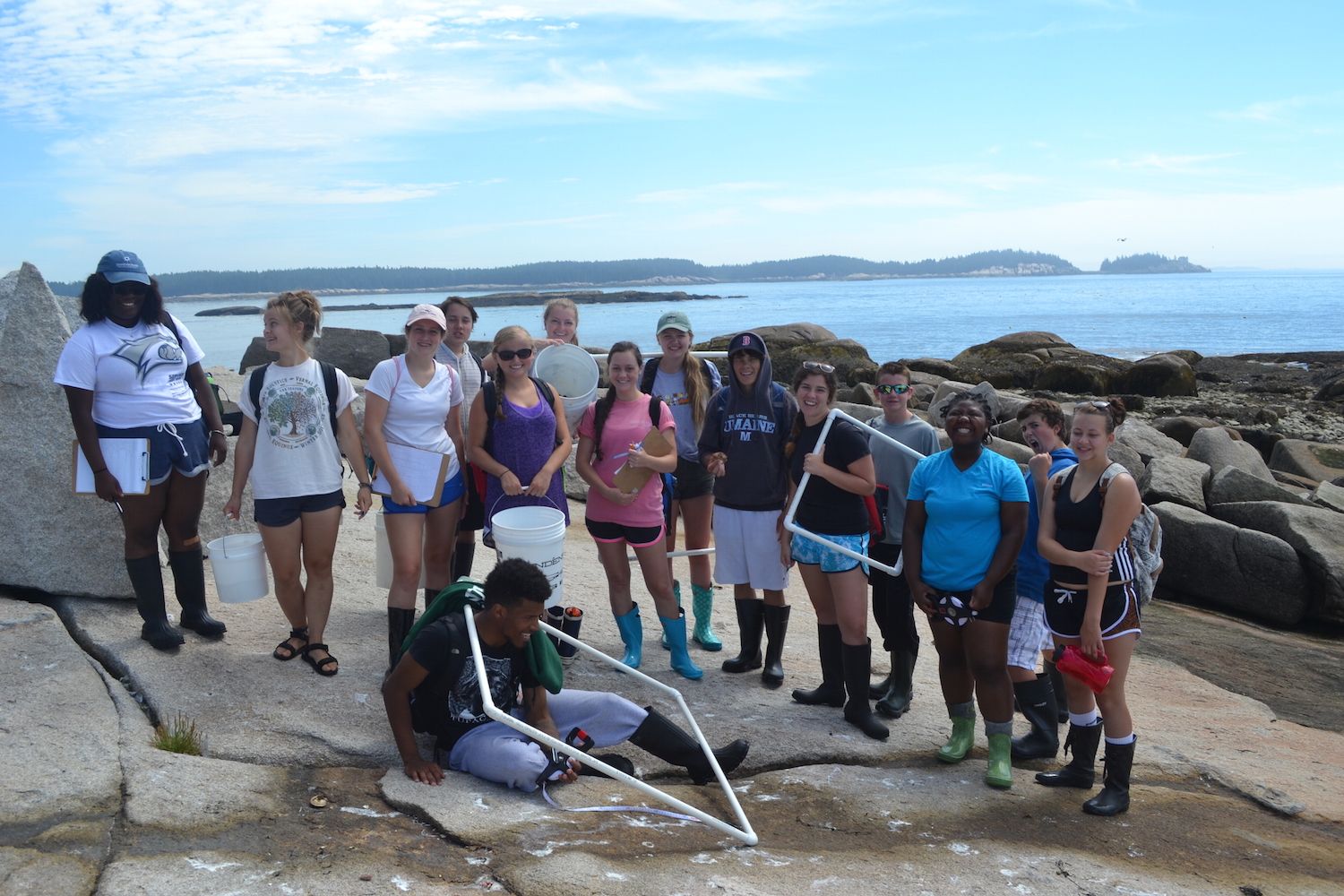
The crew after a successful morning collecting data in the intertidal at Two Bush Island

The crew after a successful morning collecting data in the intertidal at Two Bush Island

On Wednesday, each group of students set out to collect their data to support their research questions during low tide. Armed with different sized quadrats, measuring tools, and buckets, students carried out their data collection procedures that that varied from measuring and counting snails, to determining the ratio of invasive crabs to native crabs. For the rest of the morning, some students learned to rock-climb with Sam, where they strengthened their knot tying skills, learned how to safely belay one another, and challenged themselves to climbing the 60 foot rock face in the quarry. Others spent time in the lab, dissecting herring and analyzing the anatomy of a fish. We also took a closer look at plankton, and discussed why these microscopic organisms are vital for life in the ocean.

That afternoon, students built a passive drifter. This low-cost, ocean drifter is equipped with a GPS unit, and will be one of more than 1000 drifters that have been sent out to sea over the last 10 years. Drifter data, collected via satellite, are used by NOAA to track ocean currents and the movement of plankton in the Gulf of Maine. Our passive drifter, decorated with students names and the Hurricane Island logo, will soon be deployed offshore by the Rozalia Project.

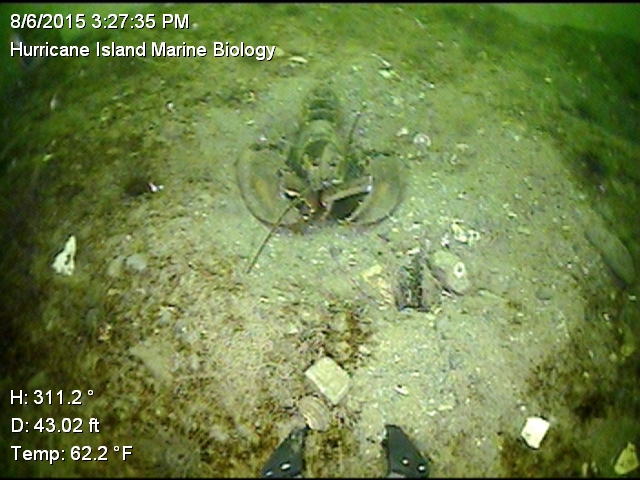
An underwater view from Hector the Collector, Rachael's ROV that she uses to help pick up marine debris.

An underwater view from Hector the Collector, Rachael's ROV that she uses to help pick up marine debris.

Thursday we took a field trip to a nearby island to conduct a marine debris cleanup along the shoreline. Students looked high and low for trash of all kinds, and in just over an hour collected 563 pieces of debris! As we collected, each piece was recorded and categorized on a data sheet, which we also update into an online marine debris tracking platform. Following our cleanup, we returned to Hurricane to attend a presentation by Rachael Miller, the co-founder of the Rozalia Project. She spoke to students about the impacts of marine debris on ocean health and how they each can contribute to a cleaner ocean. After a tour of the American Promise, the Project’s 60ft sailboat, and a look at Rachael's ROV Hector the Collector, students and staff ended the night with a campfire and s’mores, and a lesson about the stars.

With binoculars in hand, students started the last full day with a hike around the island learning about sea birds and their habitat. The exploring continued with another hike to the highest point on the island. In the afternoon, students hoped aboard a local lobsterman’s boat and headed out to sea to haul traps. On the boat, we experienced a day in the life of a fisherman, as we measured the keepers, refilled bait bags, and practiced banding lobsters. Back in the lab, Alice and Jacque assisted students as they processed and analyzed their data from Wednesday's trek in the intertidal. Students made conclusions about their results, in preparation for their presentations the next day.  

On our final day, students proudly presented their intertidal projects to the Hurricane Island staff and gave insight into the ecology of life on the shoreline. The final hours on Hurricane were spent swimming, rowing in one of our gigs, and enjoying a cookout lunch on the South End. We had a fantastic time with these students and it was sad to see them go, but we hope to see them next summer or back in the future as interns on Hurricane!

Subscribe in a reader

5-Day WFR 2015

Participants from the second Wilderness First Responder (WFR) program of our 2015 season enjoyed Hurricane Island at the peak of summer and the peak of our busy season. Along with 14 WFR participants, we were also running our Marine Biology summer program and hosting Overland students as part of their Maine Leadership program. All combined, we had nearly 60 participants and staff on the island for a sun-filled week which was bustling with activity!

Participants learn how to improvise splints using lifejackets, sleeping pads, and other available materials

WFR courses are normally a week long, so the five-day WFR is always a whirlwind of instruction. Participants split time learning in the classroom about how body systems respond to shock and stress, and in the field where staged scenarios gave everyone hands-on learning opportunities to stabilize patients suffering from a range of ailments including lightning strikes, traumatic brain injuries, and hypothermia. One of the realities of living on Hurricane is that we are in a "wilderness" setting and cannot immediately access definitive care. Safety is a priority out here, so is our pleasure to support the efforts of Wilderness Medical Associates and send more certified first responders out into the world! Congratulations, and thanks for helping save lives!

Subscribe in a reader

Circle of Trust Retreat

I think people need to reconnect with nature up close and personal if they are going to become stewards and help protect our environment, so this type of program that does just that is incredibly needed, meaningful and empowering
— Dave Oaks

The Center for Ecological Living and Learning in cooperation with the Center for Courage and Renewal welcomed 8 participants and facilitators Dave Oakes and Holly Wilkinson for a two-day Circle of Trust Retreat on Hurricane Island. The goal of the retreat was to give participants the space to reconnect with nature and experience a sense of renewal by immersing themselves in the natural beauty of Hurricane Island. Music, poetry, communal time, and solo experiences allowed participants to experience inner healing, celebrate the outdoors, and reflect on how to be better environmental stewards and continue to protect the environment.

The signature event of the retreat was a chance for participants to spend sustained time reflecting in nature and connecting to their inner and outer landscapes with an overnight solo experience. After dinner on Saturday night, participants dispersed around the island for a solo and returned to the main campus to share a silent group fire.

We were thrilled to be able to include Circle of Trust participants in a dinner that was foraged and prepared by our Island Ecology students who were also out on the island learning about the natural history and ecology of Hurricane's terrestrial landscape.

We look forward to welcoming Dave and Holly and another Circle of Trust group back to Hurricane next year!

Subscribe in a reader

Island Ecology 2015

Post by Program Instructors Chloe Tremper and Olivia Lukacic

Five high school students, a little unsure of what to expect, assembled on foggy Hurricane Island for the first day of our week-long Island Ecology program. What followed was an incredible week filled with laughter, plants, creatures, and adventures of all kinds. The students joined our community from all over New England (plus Philadelphia), and each brought their own interests, excitement, and personalities.

After everyone settled into the bunkhouse, Chloe and Olivia showed students the ropes of the main campus, went over Hurricane's sustainability systems, and shared pieces about the history of the island. We finished the day with sit spots, which are a part of the program routine. These 30-60 minute long sit spots give students time to reflect on what they learned that day, observe the world around them, and enjoy the peace and quiet that the island has to offer.

About to head out insect collecting (click through for a full slide show of photos from the week)

About to head out insect collecting (click through for a full slide show of photos from the week)

The rest of the week flew by quickly: each morning was filled with nature explorations and science adventures, and afternoons focused on sailing and rock climbing challenges.  Kevin Keegan, a PhD student at the University of Connecticut started off the students' first full day on the island exploring a group of creatures that strike fear in the hearts of many: bugs! The students were introduced to the four main orders of pollinating insects (Diptera, Coleoptera, Lepidoptera, and Hymenoptera) before heading out on an insect hunt. Kevin taught the students how to catch insects using nets and a beat sheet as well as how to properly preserve, mount, and label specimen.  Our favorite thing he taught us, however, was the art of "zenning for insects," which consists of closely examining a small area of shrub for signs of insects like curled or chewed leaves. This led us to discover a huge pile of caterpillar frass with a caterpillar hiding inside! While some high school students may have been unenthused with the idea of touching bugs, everyone had a blast catching insects of all shapes and sizes. 

Planning the layout of the pollinator garden

Planning the layout of the pollinator garden

The island ecology students left two positive, permanent marks on Hurricane.  They contributed specimens to Hurricane's new permanent insect reference collection and they also designed and planted a beautiful new pollinator garden on the south end of the island.  The garden is filled with echinaceae, flox, nepita, and more and was planted near our new hive of honeybees to benefit them and the native pollinators of Hurricane.

The students also spent a morning exploring the intertidal, learning about all of the different creatures that can be found there, followed by a perimeter hike to explore the transition from sea to land.  Another morning, the students completed a clue-based plant hunt with Ben Lemmond, a UVM masters student, to understand species distribution and diversity on the island. 

Foraged Dinner

Foraged Dinner

Later in the week we came back to botany to learn about the diversity of flowers, trees, shrubs, and ferns on the island. This knowledge was crucial for our edible feast on the last day full day of the program. We spent all morning walking the island collecting edibles including a variety of berries, seaside edibles like sea rocket and orach, and edible flowers like red clovers, elderflowers, wild rose, and nasturtiums. After gathering wild edibles, students spent the afternoon working with our amazing chef Micah to harvest veggies from our garden and to prepare and cook all the food.  The students worked as a great team and pulled off a fantastic evening - cooking an amazing meal, developing menus, setting and decorating the main hall for more than thirty people! Some of our favorite menu items included a beach rose and clover simple syrup, elderflower fritters, and a huge garden and foraged salad.

The group got their adventure on during afternoons rock climbing and sailing. We led up to our on-the-water activities with help from Sam learning about nautical charts, navigation, and some important knot tying skills. During our full afternoon sail we were able to circumnavigate Greens Island and anchored at one of the beaches to explore the idea of island biogeography and see the differences between islands in Penobscot Bay. The adventuring continued with two sessions of rock climbing. Everyone pushed their limits in climbing and belaying, and one of the students was able to complete a route blindfolded! Students also got the awesome experience of repelling down the main face over the quarry.

Throughout the week we bonded over evening volleyball games, amazing sunsets (once the fog cleared), swimming in the Atlantic ocean, raucous games of UNO, and camp fires on the south end. The week flew by and we hope the students had as much fun as we did!

Subscribe in a reader